
If you build software, RAD can make it deployable on Google Cloud as you publish it, with no fork and no licence change. If you deliver cloud work, RAD can publish your own Terraform modules and deploy them through one interface with one audit trail.
Two different readers, two different offers.
Open-source or open-core, self-hosted, with a commercial edition or a support business behind it. The first hour of self-hosting is where prospective users give up. Read the vendor half →
A consultancy, agency or reseller, with your own Terraform you re-apply for every client. The delivery is repetitive and the trail of who deployed what is scattered. Read the delivery half →
Both halves sit on the same catalogue: 350+ deployment options covering 180+ applications and platform modules, deployed into a Google Cloud project the end customer owns.
Not at the top, but where somebody who already wants your software has to stand it up.
The visitor read the docs, liked the product and opened the deployment guide. What they hit next is a database, a reverse proxy, TLS, object storage and a service account, none of which is your product.
A one-line container demo answers what the UI looks like. It does not answer whether the software survives in your cloud, under your policies, with your data beside it — the question before a purchase.
The people who push through an eight-step manual install are the ones most able to run it for free afterwards. Those who give up are the ones who would have paid for support or a hosted plan.
Interest is global; checkout is not. A developer who can evaluate your software perfectly well may still be unable to complete the payment step that turns them into a user, let alone a customer.
RAD is a deployment path, not a distribution deal. Nothing about your project changes.
No fork, no repackage, no licence change, no vendored copy of your code. RAD deploys the artefacts you already publish, and when you cut a release we update the module against it.
Authoring the module, keeping it working against Google Cloud's moving parts, and answering the deployment questions is our job rather than yours. Your maintainers keep maintaining your software.
It lands in a Google Cloud project they own, as plain Terraform, and it keeps running unchanged if they never sign in to RAD again. The Terraform state sits in RAD's own Cloud Storage rather than theirs. Nobody is locked into a middle layer in order to try your software.
The catalogue carries 60+ pre-composed solutions. Software inside one gets deployed by people who came for the bundle: a team installing a support desk or an analytics stack, who now run your project as part of the estate they asked for.
RAD takes payment through Stripe and Flutterwave, and Flutterwave supports card, bank transfer, USSD and mobile money.
RAD-managed projects run in one region in each of eight geographies, including africa-south1, the only Google Cloud region on the African continent.
Every catalogue entry has a configuration guide documenting the variables the deploy form asks about. The documentation site carries 520+ of them, plus a hands-on lab for each of the 340+ application options that ends in a working deployment.
Four steps. Nothing here requires an exclusive, and you can stop at any rung.
We author a module for your software and it appears in the catalogue alongside the rest, with a guided form, a shown credit cost, live build logs and published outputs.
You review the module and confirm it reflects how you intend your software to be run. Defaults, versions and exposed variables are agreed with you, not guessed.
Your software becomes a member of pre-composed solutions, deployed alongside what it usually sits next to. Wired pairs arrive connected; the rest are made by hand.
Joint material: the deployment lab, the configuration guide, and a route from your own documentation to a working installation. Agreed in writing, never assumed.
We will build a reference deployment of your software and show it to you before you commit to anything.
You already have the Terraform. What you do not have is a way to run it for thirty clients without it becoming thirty slightly different things.
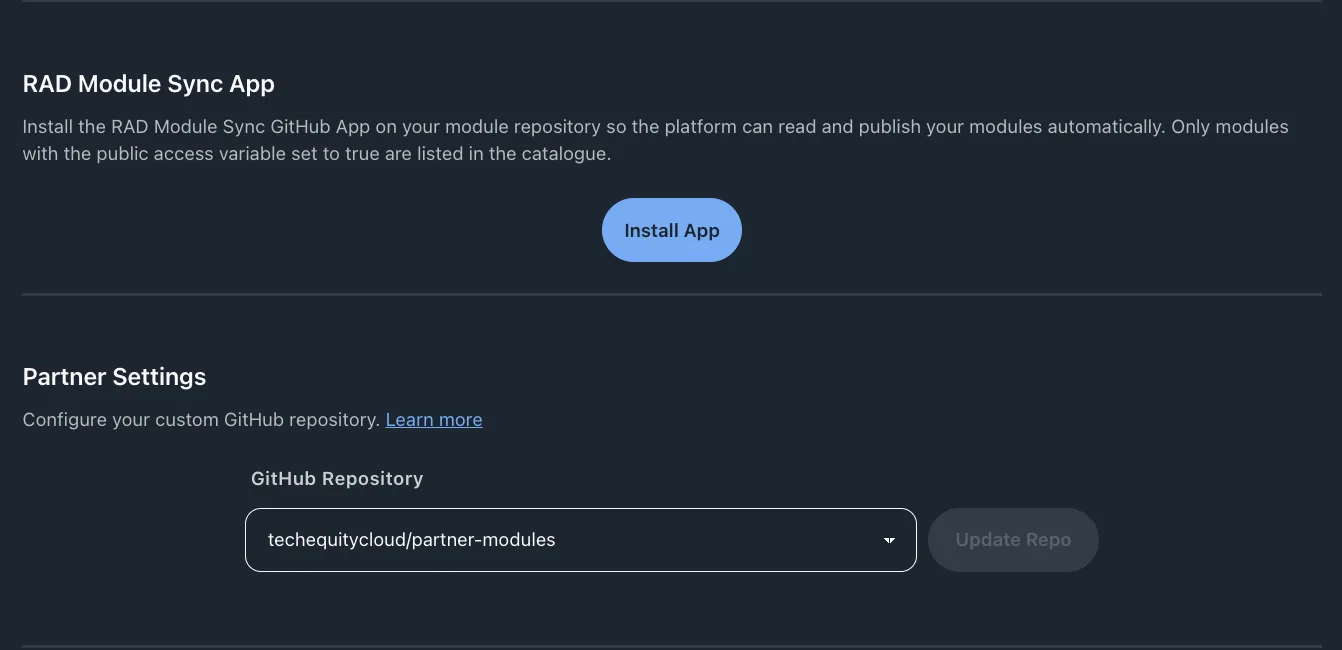
Your repository stays yours. Once an administrator grants the Partner role, you install the RAD Module Sync GitHub App and RAD syncs your modules on every push and hourly. It renders your variables as a guided form and deploys through the same engine as the rest of the catalogue, with the same build logs, outputs and teardown path. Modules are managed in GitHub; the console is read-only.
A junior consultant deploys the pattern your principal engineer designed, without a local toolchain, credentials on a laptop, or an undocumented step somebody remembers. Basic mode asks only the mandatory variables, and a first deployment is always Basic; the full set opens on update once their credit balance covers it, whether the project is their own or one RAD manages.
Who deployed what, into which project, when, and what it cost in credits. Money-bearing actions write audit records, so what you ran in a client's environment is a query rather than a memory.
Under their org policies, in any Google Cloud region, as ordinary Terraform they can read and inherit. When the engagement ends, they are not holding something only you can operate.
Anyone holding purchased credits, and every partner and administrator, can open a client project from the Client projects view of Managed Environments: the client accepts an invitation, RAD creates a production-tier project, and you fund a client wallet from your purchased credits, then top it up or withdraw from it as the work goes. The client pays you, never RAD, and sees the project under Run for you. If the wallet runs low, billing pauses rather than running on; when the work is done you hand the project over, or end it and remove what was deployed, and unused wallet credits come back to you.
A module you mark public is listed in the catalogue when it syncs, with no approval step; any other module stays private to you, or to the people it names by email. Deploying a partner's modules, including your own, needs deployment access an administrator enables for each partner.
The rates are agreed with you in writing.
Deployments of a partner-published module are charged in credits like any other: the module fee you set in the module itself, shown before the user confirms, plus a build cost metered from how long provisioning ran. Deploying your own module waives the fee; the build cost still applies.
Your share is calculated on module fees paid with purchased credits, never on build cost, and reported on the Module Revenue tab of your Credits page. Finance records each payout in the platform, at the rate that applied when you were paid, and it appears in your Payouts section alongside any setup-request earnings.
Module revenue does not include referrals. If you send clients to RAD rather than deploying on their behalf, that runs through the separate Agent role, granted by an administrator: a cash commission on the module fees your referred users pay with purchased credits.
Referred customers keep their own account, their own project and their own credits. Nothing about the arrangement puts you between them and their infrastructure.
Percentages we have not confirmed with you, and earnings projections of any kind. RAD is in beta, and a first-year revenue ladder on a partner page would be a number we invented.
Ask us for the current terms and we will send the actual ones, dated.
Two brochures set out the case at more length: the partnership proposal for open-source vendors, and the revenue opportunity for delivery partners. Neither contains a percentage we have not agreed with you.
Where the ecosystem stands today.
Modules are sourced from Git repositories, rendered as guided forms, deployed by the same engine, and charged through the same credit ledger. This is how the existing 350+ deployment options already work.
The platform and the catalogue are built and running. We are early, we have no customer logos to show you, and we are not going to manufacture any.
You would be the first. We are saying so here because you would find out in the first call anyway.
Google Cloud only, and Terraform is the contract, so a module has to be expressible as Terraform.
Seven catalogue options cannot be deployed into a RAD-managed project and need the customer to bring their own. RAD is not the cheapest way to run one small application.