
A grant pays for the resources. It does not write the Terraform, wire the service accounts, or connect one application to another. RAD does that part, into your own Google Cloud project or a governed one it creates. Start with 300 credits, no card.
Not into the product. Into the fortnight before the product, which happens again on the next environment, and again when a second engineer joins.
No investor, customer or user has ever asked to see your service-account layout. It still has to exist, be correct, and be redone for a second environment.
One technical mentor in a hub answers the same networking question for the twelfth founder this quarter. The answer is identical every time and written down nowhere.
Scripts that one person understands, a wiki page three months stale, and a deployment nobody else can reproduce. It works until its author takes a holiday.
Console clicks leave no artefact. When someone technical finally inspects what you built, there is nothing to read except the running resources themselves.
Most products need several things running, not one. RAD's catalogue holds 350+ deployment options across 180+ applications and platform modules, plus 60+ pre-composed solutions that deploy several applications together as one dependency-ordered unit — and if you are not sure which of them you need, you can describe the problem instead and have a solution composed for you.
Members with no prerequisite provision up to four at a time; a member that consumes another member's Terraform outputs waits for that specific deployment.
Where a producer-and-consumer pair is wired, RAD is designed to copy the producer's Terraform outputs into the consumer's configuration before it builds. In other solutions you make every connection yourself.
A container-based module is quicker than one standing up a Kubernetes cluster. Build cost is metered from the same clock, so a fast build costs less than a slow one.
A solution reserves its cost as one sum across every member, discounted 15% for three to four modules, 20% for five to six and 25% for seven or more.
You do not have to know the stack to start. Describe the problem — "somewhere to run our marketing site and take payments" — and RAD proposes applications from the catalogue with a reason for each. The set you accept saves as your own solution and deploys like any other. Build Solution with AI goes a step further: four plain questions, then a price for the whole chain and an estimate of how long it takes to build. Composing a solution and Build Solution with AI both come with purchased credits.

At some point somebody technical who does not work for you will look at your infrastructure: an acquirer's engineer, an investor's technical adviser, or your first senior hire. What they open matters.
What RAD provisions is standard Terraform in a Google Cloud project you own, not a proprietary abstraction to be explained before it can be judged. One caveat: the state is held in RAD's Cloud Storage, not yours, and there is no state download today.
Nothing your users touch resolves to us. RAD provisions and steps out of the way, so the question of what happens to them if you disappear has a short answer.
Stop using RAD and the resources continue exactly as they are, in your project, under your billing account. Nothing has to be moved. The state file stays in RAD's bucket, so keeping those resources under code means re-adopting them into a state file.
If the account goes quiet with no purchased credits, RAD deletes its record and that state after the retention period, warning you by email first. Your resources are untouched.
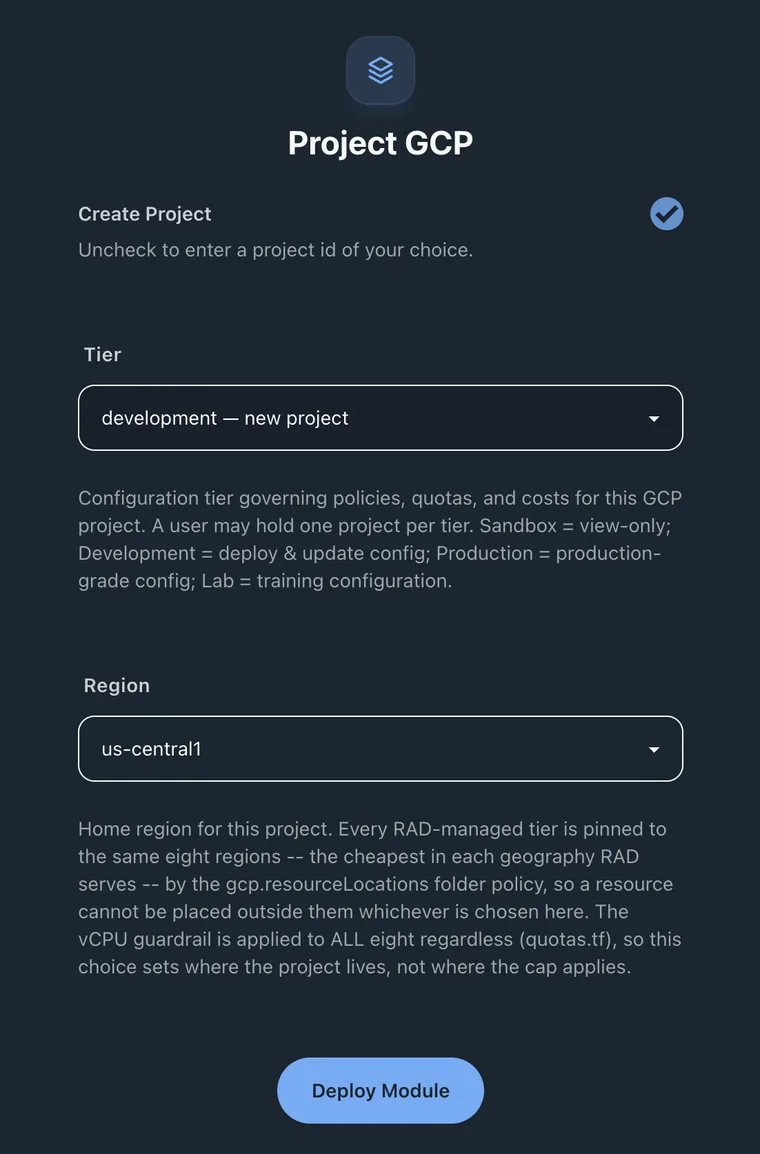
If you cannot set up a Google Cloud billing account, or do not want to run one yet, RAD creates and governs a project for you. Each of the four tiers is a separate Google Cloud folder with its own policy set.
Managed projects deploy into one region in each of eight geographies: us-central1, europe-north2, northamerica-south1, me-west1, africa-south1, asia-east1, australia-southeast2 and southamerica-west1.
Each of the eight is the cheapest available region in its geography. If you use your own Google Cloud project instead, every region Google offers stays available.
The production tier carries development's ceilings: 48 Compute Engine vCPU and 32 Cloud Run vCPU per region, 32 GB of Memorystore Redis per region, 1 TiB of BigQuery scan a day, and no GPUs.
A workload that grows past one of those is refused until that quota is raised for your project. In your own Google Cloud project, none of these apply.
A Google Cloud budget alert notifies as spend approaches and exceeds a figure. It does not block an API call.
If your purchased credit balance falls below the minimum for the project’s tier, or its Google Cloud usage goes unpaid, RAD is designed to disable Google Cloud billing on the project it created for you, and to restore it when you top up. It only ever reverses a suspension it applied itself.
Free monthly credits do not qualify. The minimum is set per tier, and all but a short, named list of options are eligible to go into a managed project.
Two payment rails, and RAD never handles card details.
RAD accepts payment through Stripe and Flutterwave, which offers card, bank transfer, USSD and mobile money, so a founder without an international card can pay.
Checkout is hosted by the payment provider. Credits are granted only after that provider confirms the payment, on the server, once per payment.
A RAD-managed project can be created in africa-south1, Google Cloud's only African region, or any of the other seven. Your own project keeps the full set.
Credits are the unit: 10 credits = $1. Two things are charged, and you see the first one before you confirm anything.
No payment method is required to sign up. Free users deploy into their own Google Cloud project and pay Google directly for the resources.
A handful of infrastructure and reference options carry no module fee, including the one that creates a RAD-managed project. The fee is shown in the confirmation step before provisioning starts, alongside the balance it comes from. A failed build carries no module fee.
Charged at a published per-hour credit rate against the time the build really took. Most modules build in well under half an hour.
Free monthly awards refresh each month and do not accumulate; event-code credits expire on their own date; subscription credits currently roll over into the next cycle; credits you buy outright never expire. Spending always draws on the soonest-to-expire balance first.
If you run a cohort, RAD can give every founder a real, governed Google Cloud project on the same morning.
A programme lead with the Trainer role builds one governed project and one deployment per founder, in one action from the Lab sessions view of Managed Environments. Each runs for up to 24 hours and is then deleted.
Chosen when the session is created: the lead funds every place from escrow, or each founder buys their own. Whatever the founders did not use returns to the lead when the session settles; a place whose clock never starts is refunded to whoever paid for it.
A code gives attendees free credits for module fees and build time: once per account, before a closing date, and optionally limited to named attendees or an email domain.
An organisation that brings founders can hold the Agent role: a cash commission on the module fees they pay with purchased credits. We agree terms directly and publish no earnings figures.
They are newer than the rest of the platform. We want pilot partners. If you run a programme, talk to us and we will work through it with you.
Three reasons to close this tab, offered up front.
Every module targets Google Cloud, and Terraform is the contract. If you have already committed to a different provider, nothing in the catalogue helps you.
If your whole product is one container one person maintains forever, a small host costs less. RAD pays off when several things must run and be governed.
The catalogue, the engine and the documentation are built and running. Lab sessions and the trainer role are the newest parts, and are still early access.
Sign up, pick something from the catalogue, and deploy it into your own Google Cloud project. If you do not have one, RAD will create a governed project for you. If you run a hub, tell us about your cohort instead.
Running a hub and need something to circulate? The startup-hub brochure makes the same case in one document, with the per-company cost worked through.